


Recovery
Project: Bioconversion of coal into fuel using enhanced engineering pathways

Dr. Sushanta Mitra
The Research
This large multi-institution research team led by Dr. Sushanta Mitra is trying to coax subsurface microorganisms (methanogens) to efficiently convert coal into natural gas (methane) for use as a fuel. Not only does methane burn cleaner than coal, it also generates an equivalent amount of energy. During the course of this research, the bioconversion process will be examined at different scales – from nano to lab and, eventually, to field-scale. By studying microbial species, biochemical pathways, and the nutrient and methane flow involved in the bioconversion process, researchers will be able to determine the best environmental and biochemical conditions microbes need to degrade coal.
The end goal of the project is to use biological processes in the field to convert deep, unmineable, low grade, sub-bituminous coal into gaseous or liquid fuels at sustainable economic rates. This will provide a greener alternative to conventional coal combustion. Mitra’s research has the potential to reduce net carbon emissions by a factor of 25% or more – or approximately 37.5 million tonnes a year.
Research Grant
$1.92 million/3 years; Awarded 2010
Benefits to Canada and beyond
Coal, which is burned primarily for electricity generation, accounts for roughly 39% global carbon dioxide emissions. With world demand for energy increasing, and coal continuing to play a major role in energy production, ways are being sought to harness the energy of this fossil fuel in a carbon-efficient manner. This technology has the potential to reduce emissions from coal-fired power plants by 25%. In a carbon-constrained world, Dr. Mitra’s research will offer Canada and other countries a new tool to help reduce carbon emissions and mitigate the impact of CO2 on climate.
Industrial Applications
As well as reducing emissions from coal-fired power plants, this technology will allow companies to harness the untapped energy potential of deep, unmineable coal by converting it into gaseous or liquid fuels at sustainable, economic rates.
Project Partners
New Paradigm Engineering Ltd. is helping to locate useful field sites. Encana is providing funds to project researchers at Alberta Innovates Technology Futures. Sherritt Coal has offered coal samples for use in analysis and core-flooding experiments
Lead Principal Investigator
- Sushanta Mitra, University of Alberta
Principal Investigators
- Karen Budwill, Alberta Innovates Technology Futures
- Julia Foght, University of Alberta
- Subir Bhattacharjee, University of Alberta
- Thomas Thundat, University of Alberta
- David Nobes, University of Alberta
- Gordon Southam, University of Queensland
- Marc Secanell, University of Alberta
- John Shaw, University of Alberta
- Ian Gates, University of Calgary
- Vinay Prasad, University of Alberta
- Bruce Peachey, New Paradigm Engineering Ltd.
Post-Doctoral Fellows
- Prashat Waghamare, University of Alberta
- Siddartha Das, University of Alberta
- Abigail Adebusuyi, University of Alberta
Graduate Students
- Arnab Guha, University of Alberta
- Dan Ritter, University of Arizona
- Jenna Shelton, University of Arizona
- Abhishek, Batwara, University of Calgary
- Jacky Wang, University of Calgary
- Gouthami Senthamaraikkannan, University of Alberta
- Jeremiah Shuster, University of Western Ontario
- Lalit Pant, University of Alberta
- Anil Stephen, University of Alberta
- Mehrnaz Rahimi, University of Alberta
Research Associates, Technicians, Project Managers
- Hazel Robinson, University of Alberta
- Haiping Huang, University of Calgary
- Twyla Malcolm, Alberta Innovates Technology Futures
- Wanyu Chen, Alberta Innovates Technology Futures
- Mark Olson, Alberta Innovates Technology Futures
- Trish Rattray, Alberta Innovates Technology Futures
- Stephanie Trottier, Alberta Innovates Technology Futures
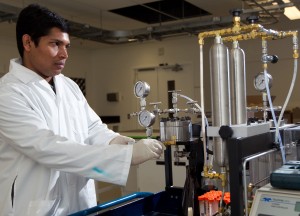
Anil Stephen in Nano-Bio-Energy Network lab
Goal
The goal of this research is to understand the components (microbiota, biochemical pathways) involved in the bioconversion process of coal to methane. The team wants to determine the rate limiting steps of this process and develop methods to overcome these limitations in the bioconversion pathway. The eventual aim of the project is to move testing from the lab into the field.
Activities
The team is studying the complexity and variability of coal. High-resolution microscopy is being used to examine the pore structure of coal as well as the microbial-coal interface.
There is a lack of knowledge of basic biodegradation systems and reactant transport. A novel device called a Reservoir on a Chip allows the team to see how fluids are transported through tiny pores in rock at a miniature scale. Lab experiments and computer models (fundamental scale modeling) are also being used to investigate nutrient and methane flow through coal.
The microbial species involved are being detected with DNA analysis in addition to core flooding experiments. Cultured microbes are flooded with nutrients and the resulting methane production is recorded with sensors.
The team is also working on plans to test the bioconversion system at field scale.
Key Developments
A new facility, the Nano-Bio-Energy Network, has been established at the University of Alberta. The network was created to foster and support the collaborative efforts of experts from nanotechnology, biology, and energy. Mitra believes this holistic approach to problem solving is essential in dealing with today’s complex, multi-faceted research challenges.
For additional information
Dr. Sushanta Mitra
Department of Mechanical Engineering
University of Alberta
Edmonton, AB, Canada T6G 2G8
T: 780 492 5017
E: sushanta.mitra@ualberta.ca
W: MNT Lab